Showing posts with label Mark Rashid. Show all posts

Monday, March 14, 2016

Mark Rashid Clinic March 2016: Final thoughts

Today was the last day of the clinic.  Brett and Pistol did a review of their exercises from the previous two days and then spent a good amount of time working on trot work.

Brett's goal was twofold.  First, he worked on getting the walk-trot transition from thought.  Secondly, he worked on Pistol's trot.  Pistol has a tendency to throw her head in the air and hollow her back at trot.  And she tries to break into a lope -- trotalope, as Mark calls it.

Brett was able to get Pistol to relax and carry herself in a more balanced frame by turning her whenever she rushed or braced.  They had some lovely stretches of trot.

Brett said he's never enjoyed trotting so much -- no pressure and riding from thought.  Mark said that Pistol didn't look or act like she is 20 years old.

It was another very successful clinic for Brett and Pistol.

Tex and I reviewed our work as well.  I thought we would quickly lunge, I would take Tex to the mounting block, get on and work on whatever Mark felt we should do.

It didn't go that way.

We reviewed lunging.  Tex and I had great connection and he tuned into me, getting lighter and quicker and smoother as we went along.

Then we went to the mounting block and Tex nailed lining himself up (we had also practiced that some on our own earlier).

And then Mark said, "I don't want you to get on him.  He isn't safe."

My heart sank.  He was right, and I knew it, but I was disappointed nevertheless.

Mark talked to me at length about how reactive Tex is; even with me.  He still flinches when I touch him and he about jumped out of his skin when Mark approached him.  This was after Mark worked with him two days in a row and gave him nothing but kindness.

I am looking at three scenarios.

1.  Tex may have PSSM or some other medical condition that is causing him to be reactive.  I am going to take him in for a complete work-up as soon as I can get an appointment.  If the reactive behavior it tied to a medical condition, we may be able to manage it and he may eventually (say in six months) be rideable.  ...there's a lot of "ifs" in there and, I have to say, I'm not feeling very optimistic.

2.  Tex may be reactive because of his breeding.  Here is his pedigree.  I don't see any "repeats" but it also only goes back three generations.  If the issue is breeding, there is nothing we can do.

3.  Tex may be reactive because that's just how he is.  Mark held his hands out, shoulder length apart, and said "this is the range of normal re-activity in horses.  There is variation, but most horses fall somewhere within this range."  He stretched one hand further out, the arm almost straight.  "This is where Tex is."  If he reacts to something, and he will at some point, it would be dangerous to be on his back.  Tex isn't mean; he's a very kind horse with a ton of try.  But he's a flight animal with a hyper-sensitive flight reaction.

So, if we end up with scenarios 2 or 3, I will never be able to ride Tex.  I will still work with him of course.  There's lots of stuff we can do on the ground and we have a good, strong bond.  I don't want to lose that.  I just want him to be comfortable and confident -- at whatever level that may be.

I won't deny that I was pretty depressed on the drive back home.  Maybe we'll find some straight forward medical reason, maybe he'll respond to management of that condition, and maybe in six months (when all that has a chance to work), I'll be able to ride him.  Maybe.

Sunday, March 13, 2016

Mark Rashid Clinc March 2016: Day 2

Brett was first up this morning again.  He and Pistol started with a review of their turns on the forehand and turns on the haunches -- and they nailed it.  So, they did a few side passes and nailed those as well.

Mark's approach to side pass is different, in an interesting and positive way.  Basically, Brett alternated the aids for turns on the forehand and on the haunches so that the front feet crossed, and then the back.  In this way, the horse (Pistol in this case) was able to understand the method/reason behind the movement and to think instead of just react.  She moved front, then back, and then the two movements merged into a fluid side pass.

The side pass work was interspersed with trot breaks.  Pistol was initially overly ambitious; trying to "trot-alope," as Mark described it.

To get Pistol to relax, Brett asked from thought followed by a whisper of leg -- she was really close to getting it completely from thought.  She transitioned into a beautiful, smooth, relaxed and balanced trot.  It was so beautiful, that I just sat and watched and completely forgot about the camera.

I had a few minutes before going into the arena for my lesson, later in the morning, so I walked Tex out to the obstacle course.  We had spent some time out there yesterday afternoon with Pistol, and Tex was stellar.  He didn't do everything but he didn't snort or spook either.  He studied the bridge, and the teeter-totter, and the logs.  He wasn't too sure about the cowboy curtain but did eventually follow me through.  We worked on it again this morning and he followed me through (rushing a bit, yes, but still).

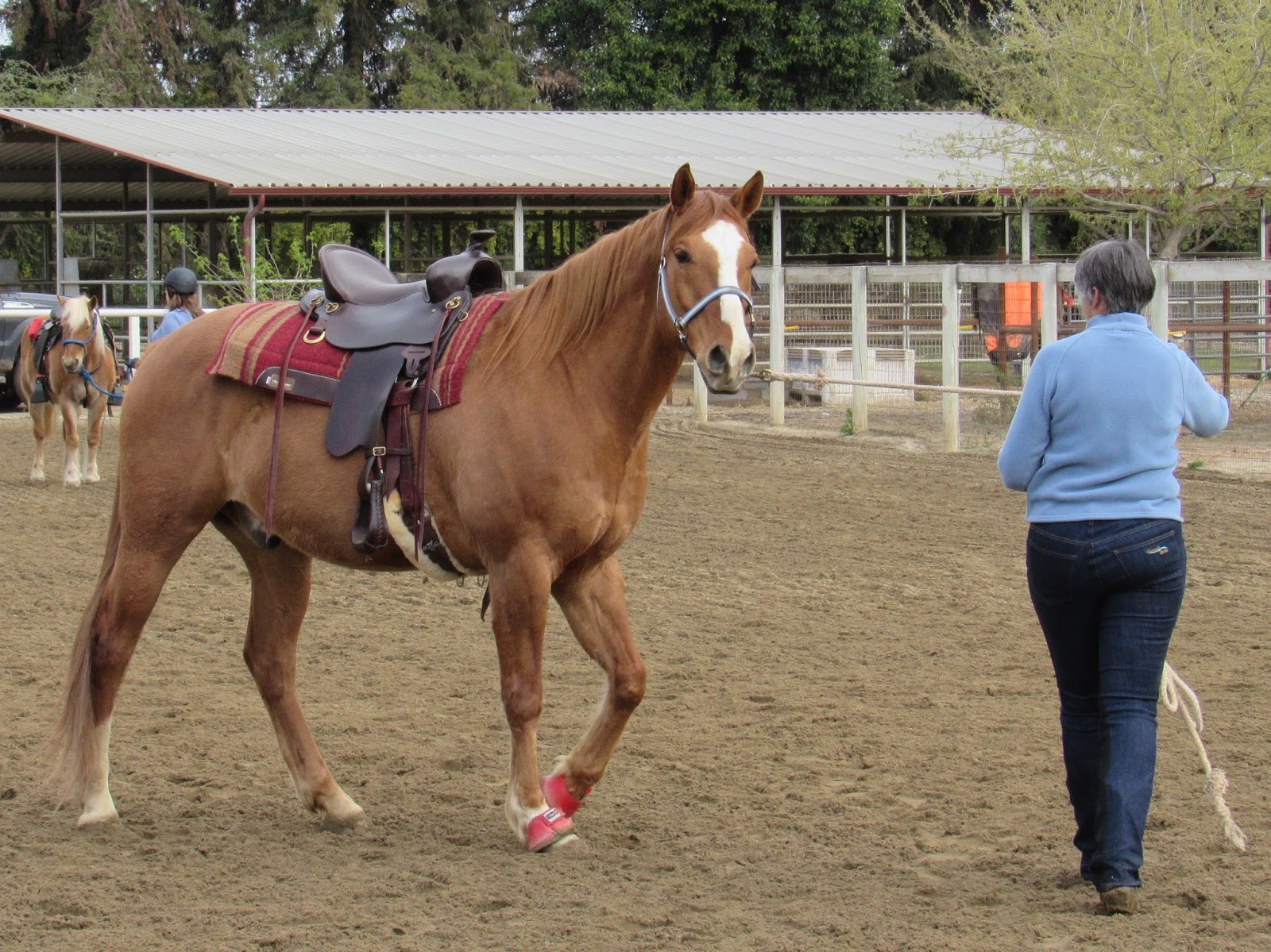
For my lesson, we began by reviewing lunging.

The main focus this time was to get Tex to relax through the change of direction transitions.

When we got that going smoothly, I asked Mark to help us with the mounting block.  I demonstrated our "usual" mounting block method.  I walk Tex to the block, line him up,

then climb up the steps -- and if he hasn't swung away while I'm mounting the steps he does it when I get to the top.

So, I climb back down, line him up, climb the steps...

No, no said Mark.  You are teaching him that moving away is what you want.  When he moves away, you get down and lead him off.  That's a release.  You want him to come to you and to stay.

Mark worked with Tex first.  He climbed up on the block and sent Tex to the side of the block.

Then, from the top of the block, he guided Tex to where he wanted.

If Tex swung his butt away, Mark stayed on the block and moved Tex back over to the side - and started over.

Eventually, Tex stayed put and Mark gave him a lot of praise and rubs on his neck and butt.

Then Mark climbed down and led Tex off.

When he was being consistently successful, I worked with Tex.  Once he understood, he was more than willing to stand quietly at the block and get a massage.

The other thing that Mark mentioned is that I should consider having Tex tested for PSSM.  It is a genetic condition, common in Quarter horses, that makes them uncomfortable, reactive and to have hard muscles (almost like tying up).  He asked if Tex likes to roll or lay down.  I said laying down, not so much; but there isn't a horse on earth who likes to roll more than Tex.  He rolls back and forth seven or eight times; stands; goes back down and rolls a dozen times more.  This is apparently a symptom of PSSM; horses roll to try to get comfortable.  I called our vet and she said I can send a piece of Tex's mane to the University of Minnesota equine lab and they can run the test directly for me.  I will do that as soon as we get home.  There is no cure for PSSM, but it can be controlled with diet and exercise.

(Lytha, on your line breeding question, Mark suggested looking back five or six generations.)

Saturday, March 12, 2016

Mark Rashid Clinic March 2016: Day 1

Brett and Pistol were first up this morning.  The arena was pretty sloppy but, thankfully, the rain had stopped.  We came down yesterday, driving through torrential rain for five hours.  We were asleep by 8pm -- Brett exhausted from dealing with semi spray on the freeway and me fighting a cold.

Mark Rashid had Brett work on turns on the forehand and turns on the haunches.

He said that Pistol is a "been there, done that, solid citizen horse."  Brett struggled to get the timing and flow right for the exercises and Pistol kept her patient, willing attitude throughout.
Turn on the haunches; rock back to elevate the front and then turn -- smoothly
I don't know about everyone else, but I think that taking lessons/training/improving is 90% feeling like a dork and 10% getting it right.

Brett did get it all coordinated and they ended on a very good note.

I had time to put away the camera and get Tex ready; then we were up.  Mark remembered Tex from a year ago; Tex had a major meltdown and Mark saw the fear and flee that consumed Tex.  You can read about that here. We talked about the work I've been doing with Tex and I mentioned that Tex is unable to flex on a circle and can't figure out lunging.  Mark thought we should start with lunging and asked me to demonstrate what I've been getting.
Demonstrating our slow, small circle at walk.

He watched us for a few minutes and then walked over.  "I can fix that in five minutes," he said while taking the lunge line from me.  And he did.  Tex initially did the same thing with Mark, swinging his haunches away instead of going in a circle.  Mark fixed that in a minute or so; sending Tex around with his body language.

Tex initially went into "flee" mode, racing around like a demon.  Then he settled as Mark continued to give direction with his posture.  When Tex was able to do walk-trot-walk transitions calmly, Mark changed direction.  Tex fled again, but came back sooner.

Last, Mark worked on changing direction.  Then he handed me the lunge line.

He told me to walk with Tex instead of standing still and having Tex go in a circle.  Tex needs the feedback of me walking.  I was to regulate whether we walk or trot with the speed of my walk.  To halt, I stopped.

I started by walking with my body angled behind Tex, as Mark had done.  Mark corrected me, saying that Tex knows and trusts me so I could immediately connect with him.  Mark angled his body away from Tex, to give Tex space and remove pressure.  Tex remained relaxed when I connected and we worked in perfect sync.  I would have cried but I'm pretty sure that is bad form during a clinic lesson.

By the end, we were changing direction, doing transitions, and walking in and out of lunging v. leading.

Mark noted that Tex is very willing and tries hard.  He said that someone in his early training may have taken advantage of his trainable personality and over-loaded him with too much, too fast.  And, clearly, he's been roughly treated.  He said that I did a good job with Tex and that we may be able to work through Tex's issues.  He suggested that I check Tex's registration papers to make sure he hasn't been inbred; if so, we're pretty much sunk.  If the flee response is the result of poor breeding then there isn't much we can do.  I've looked at his papers in the past and I don't remember seeing the same name twice so I think we're good.

Besides, I believe Tex can get there.  I believe we can get there together.

Friday, October 23, 2015

Random Friday

1.  Here's a link to the apple tart recipe for those of you who requested it: Brown Butter Apple Tart

2. Brett is at the Mark Rashid clinic through today.  He'll be heading home after his lesson, hopefully arriving in time to help with the evening chores.  I asked him to ask someone to take pictures Thursday and he did that.  They will be sending me the pictures and I will share them with you.  The clinic is four hours away and I couldn't take any time off work to go and watch.  I want to see pictures too!

3.  Thursday, Brett and Pistol had another good lesson.  They spent most of their time with Mark working on lateral work: leg yield, turn on the forehand, and turn on the haunches.  Pistol leg yields like a dream but she had some trouble with turning on the forehand.  She couldn't quite get coordinated enough to cross her hind feet correctly as she pivoted around her front legs.

4. The nights are getting cold; it has been in the low 40s when I do the morning chores.  I love this weather; I love the bracing breeze, the mix of colored leaves and acorns on the ground, the golden light, and the first fires in the wood stove.  I roasted a chicken for dinner the other night and made a big batch of applesauce, full of brown sugar and cinnamon.

5. The chickens continue to molt.  How long does this go on?  We've never had chickens molt all at the same time before.  Our egg production is down from an average of 6-7 eggs per day to one or two.  Production typically slows way down in November when the days are short and cold but it is only October and these are young chickens.

Wednesday, October 21, 2015

Mark Rashid: Day 1

Poor Pistol.  I don't think she's ever worked so hard in her life.  Brett called and told me about his first ride today at the Mark Rashid clinic.

Mark remembered Brett -- and Mufasa.  He said that Brett's decision to stop riding Mufasa was a good one; the right one.  And he thinks Pistol is a good little mare; a bit fat, but a good mare.

They spent most of their lesson working on Pistol's trot.  Mark complimented how smooth her trot is and how quiet Brett keeps his hands.  He wanted Brett to take a little more contact, to keep Pistol from diving low with her head.  Once Pistol figured out where her poll was supposed to be she started working through her body really well.  Brett said he could feel her stepping under and pushing from behind.

They did a little bit of canter work but Pistol was out of gas at that point.  Brett hosed her off and put her back in her stall.  Brett said she was too tired to eat -- and that's saying a lot for Pistol.

The best part was the joy in Brett's voice when he talked about his ride.  I never heard that when he rode Mufasa.  I didn't even hear it when he rode Flash in lessons (at mounted patrol training, yes, for sure).  Flash was very heavy on the forehand and he braced like crazy.  Pistol does neither.  And Brett rides well now, he's not the novice he was when he got Flash.

Pistol and Brett are really good together.  Happy, relaxed and connected. He has two more days at the clinic; two more lessons with Mark.  I'll  keep you posted.

Monday, March 23, 2015

What I Learned from Mark Rashid

I went with Brett to his clinic with Mark Rashid.  I wanted to be there to support Brett, but I was also intensely curious to see this guy at work.  Even though I'm one of "those dressage riders" Mark disparages a bit, I am in lock-sync with his approach to horses.  My primary hope for the clinic was that Mark would help Brett and Mufasa; that Mufasa would learn to trust a bit more and that Brett would learn to ride from a place of energy and feel.  There was no doubt in my mind that Brett could do it if he just understood how.  The results on both those fronts blew the lid right off of my expectation box.  You know that from my last three posts.

While Brett took care of Mufasa and practiced directing his energy to pull Mufasa to him, I was busy watching all the other rides and absorbing things to apply to my riding.  My attraction to dressage isn't the "tricks" or the fancy moves, although they are very cool.  I want the harmony between horse and rider, the unspoken felt connection that creates a dance between the two of you.  I felt it first with Starman -- we did our transitions based on thought and they were mind blowing in their accuracy because we were in perfect sync.  I was trying to get there with Jackson, and we were making progress, before he was retired.  Winston -- nope, never.  But with Lucy I know we can get there.  She is already very light and I have been working on getting to softness.  As Mark says, "Light is not the same as soft."

I ride Lucy with contact; just enough so we stay connected but I never pull.  I was pleased to hear Mark talk about being close enough through connection to communicate.  Most of the time, Lucy carries herself and I just keep myself in balance, soft and following so I don't mess her up.  Mark talked about doing just that so I will continue to concentrate on keeping my shoulders, arms and elbows soft while riding.  Lucy is incredibly responsive when I am soft.

Lucy hates walking under trees.  I have no idea why but she just can't handle it.  Mark talked about one of his horses that is fantastic at everything he does except trail rides through the walnut groves.  Marks advise was to work on it with the horse if it is of critical importance to you but if not, to just let it go.  And don't take it personally. We all have things we are better and worse at; things we like or don't.  Lucy will be happy to know that I am not going to keep walking her under the trees that make her nervous.  She is gold in the arena and brave about most things.  I don't personally care about walking under trees and if I do get the urge to do so both Pistol and Jackson love it.  I'm going to let that go.

Lucy is also not a fan of having her ears touched.  I'm going to practice some energy work on that.  She's a bit head shy (nothing like Mufasa was) at times so I'll use the same technique of resting my hand and releasing when she gives.  Of course, there are also days when she snuggles her head between my arm and my belly in a hug -- like a dog will do when you stop petting them.

I loved how Mark taught backing.  Lucy and I haven't done any backing work but I'm going to start.  I want to get to fluid walk-halt-back and eventually add turn on the haunches.  ...and do it with 0.5 pressure (or less); doing it from thought would be awesome.

And if Jackson stays sound, I'm going to continue learning to dance with him as well.

Lastly, I'm going to learn more about Masterson touch therapy and try to master the technique.  Mark's wife, Chrissy, does body work and she worked on Mufasa before we headed home yesterday afternoon.  He loved it.

Sunday, March 22, 2015

Mark Rashid Clinic: Day 3

This morning Brett had his third, and final, session with Mark.  While Brett was tacking up Mufasa, there was some commotion and Mufasa pulled back on the lead line.  Brett released the quick-release knot and Mufasa settled down.  At the start of his lesson, Brett asked how best to help Mufasa in a meltdown.  Mark told Brett to act like nothing happened; to go about his business as usual.  This boy, he said, needs confidence from you.

Then they got to work under saddle.  Mark noted that Mufasa has questions about his job under saddle and this leads him into worry.  Brett needs to always go back to the foundation/basics between he and Mufasa.  He needs to get a positive response from Mufasa with pressure at less than one (on a ten point scale).  Mark explained the Japanese concept of Maai, which means shared space.  There is shared space between everyone and everything.  Most of the time, things just go along but when things go bad, the person in charge of the space is important.  Brett needs to be close to Mufasa at first by maintaining light contact with the reins.  If the reins are too long, there is too much space, and Brett can't be there to help Mufasa.  Brett needs to feel the point of meaningful resistance in Mufasa, the point at which Mufasa starts to do what is asked of him in a movement.  The amount of resistance created is very small.

They started with work on the halt.  This is how Mark explained how to teach Mufasa a soft, light halt.
Don't release in halt until he gives.  Don't pull -- either of you.
Keep Mufasa's head straight.  If his head is off by one degree, his hind will be off by three.
You need to give and soften in the stop; not push him into your hands.
Stop internally first; think about stopping; it isn't a physical change.  (Mufasa hesitated, feeling for Brett).  Eventually thought will be all he needs.  Think about stop, then stop, and wait -- look for a stop with no brace, with softness.

Turning:
Turn without the outside rein (Brett was trying to use inside leg to outside hand).  Don't use your leg.  You don't want to set up a brace.

Backing:
Shorten the rein.  Take contact and wait.  Keep his head straight.
Getting the distance correct in the contact is key.
Don't let him do it for you.  If you pull, he has to push.  Hands low. Give him time to figure it out.

The backing work cleared up misunderstanding for Mufasa.
The initial brace is why he had trouble.  He was waiting to be pulled back.  Mufasa needs to work it out himself and do it.  His feet were going backward before (when pulled into a back) but not his mind.  It's like memorizing the answer of 1+1=2 without learning how to add.  Mufasa needs to learn to add; to think; to feel better because he understands.  By waiting for him to figure it out, without pressure, you are showing and not telling.  You are doing this together.  Help him by explaining what the heck we're doing.  He's offering stuff (sideways) we don't need because it's how he got release before.  Pick something on the fence as a target and use that to keep his head straight.  If you look at the back of his head, you will go in circles.

Mufasa figured out that he needed to go backwards and took a few steps back.  With a little more practice, Mufasa was floating backwards with 0.5 pressure from Brett.  It was beautiful to watch and Brett couldn't believe how it felt (neither could Mufasa).

Mark continued:
We want this same soft feeling in everything we do.  He gains confidence because there is consistency in everything you do.  If he doesn't understand, it feeds anxiety.  You want him to wait for you, not have him take you.  That's the leadership he needs. 

Brett walked a very relaxed Mufasa around.  Gather the reins, think about stopping, stop, wait for him to soften.  When you get him home, stay consistent.  Have the attitude, "How can I help you with this?"  You have his best interest in mind.  Stay in walk until you have reinforced the feel.  If you have good feel, you don't need to back.  He's a good guy with a lot going for him.  Even with his issues (which will drop away), you bought a good horse.


Brett and Mufasa have a lot to practice before the next clinic with Mark.  Because there is no doubt that the next time Mark comes to California, Brett and Mufasa will be there.  We felt fortunate to have the opportunity to have Brett ride in the clinic with Mufasa.  Many of the other riders came from too far away (Washington, Alberta Canada) to bring their own horses so had to rely on ones at the barn.  One guy trailered his horse down from Oregon, a two day trip.  We were only four hours away, closer than most of the other participants.

Mufasa was happy to get home tonight.  He immediately rolled in the pasture and got caught up on the news from Flash.  I can just hear Mufasa saying to Flash, "Guess what?  Being with people is a good thing!"

Saturday, March 21, 2015

Another Amazing Session with Mark Rashid

Another excellent session today.  I'm going to give you my notes -- most of it direct quotes from Mark as he worked with Brett and Mufasa.  Brett brought Mufasa into the arena, without tacking him up, expecting to work in the round pen.  Instead they worked a bit in the arena, reviewing and adding to the work from yesterday:

Mark: "Move with him and towards him.  Don't act like there is a problem.  He feels the need to flee. He has learned to move away from people when worried.  He needs to learn to come towards people when worried.  Moving away should not give him a release.  (Mark had his hand lightly resting on Mufasa's neck or forehead).  Go with him.  Don't add pressure but don't release.  Release when he comes back to you.  Your hand is following; not pushing.  He is learning a different way of helping himself."

Mufasa initially moved away from the contact by turning his head or stepping backwards; he didn't flee.  Mark stayed with him, and Mufasa turned and moved towards to Mark -- getting an immediate release.

Mark: "You see this a lot with dogs.  Horses don't want to feel how he feels.  Whatever happened in his past, happened.  We can't change that and the details aren't important.  Don't reward him for being scared (it's like dogs who are afraid of thunder).  Mufasa's response has been to escape/run when he gets worried.  If he is allowed to go (if the hand is released instead of following) then he is being rewarded for the escape.  It's a double reward."

"Today, he isn't head shy.  The work yesterday, moving his head and the energy work, helped with that.  Today his energy is toward us.  All he wants is to feel better.  This is a tribute to how good a horse he is; that he doesn't hurt anyone."

Mark moved his hand over Mufasa's body, stopping with it resting on Mufasa's back.  "My hand stays on his back until he finds a way to stop moving and relax.  Inadvertently, he has been taught to feel bad.  He doesn't want to feel that way.  He's nowhere close to where he was yesterday.  This is big improvement.  Today we can do more.  Don't tiptoe around him."

Mark felt his shoulder and noted that it was very tight.  He proceeded to massage it and Mufasa shifted so that Mark could get his fingers in deep, behind the scalpula.  Mark was impressed that Mufasa was doing his part to help find the release of the muscle tension.

Mark continued "He can't distinguish between how he feels and how he acts.  We need to break that pattern.  We are trying to make everything easier so he can learn that it can feel good to work with people."

There was still about 20 minutes left of the lesson so Mark sent Brett and Mufasa out to tack up.  Mufasa was very relaxed -- the most relaxed I have ever seen him.  Amongst the auditirs, there wasn't a dry eye.

Brett asked how he much he should work with Mufasa on the touching and release exercises.  Mark said that Brett should note how Mufasa is, each step from haltering to saddling to riding.  If it is worse, stop and address at that point.  Having Mufasa relaxed on the ground first will really help.

Meanwhile, Brett and Mufasa were walking around and Mufasa was yawning and stretching.  The nest step, which they will work on tomorrow, is for Brett to be a good leader.  Brett needs to be nice about it; but he needs to give direction.

I can't wait for tomorrow's session. Brett is on cloud nine.  His eyes were pretty leaky too.

Friday, March 20, 2015

Mark Rashid: Day 1

Brett tacked up Mufasa, went into the arena, mounted and rode over to Mark.  After listening to Mufasa's history of being head shy and having difficulty trusting, Mark suggested taking off the tack and working in the round pen.  He wanted to see how Mufasa reacts to strangers and felt that if they could work through the trust issues, the rest would fall into place.  We got the tack off, and then Mufasa ducked out of the halter; heading over to a patch of grass to eat.  In typical Mufasa fashion, he didn't run from Brett but eyed him with a bit of trepidation stepping a few steps away each time Brett approached.  Others walked over to help and that pushed Mufasa over the edge.  He left, running down the track that runs around the barn.  Brett went one way and I went the other -- Mufasa, realizing he was trapped between us, ran into an open paddock.  Mark walked over and worked with Mufasa in the paddock.

Mufasa wasn't being "bad."  Mufasa was scared.  He was running like a deer -- bounding with his tail in the air.  Mark said Mufasa was so bunched up with fear that he couldn't think and he wasn't breathing.

Mark explained the four phases of fear in horses.
1. The horse goes on high alert; prepares to flee.
2. Fight
3. Flight (run as fast as you can)
4. Relax and shake it off.

Mufasa was stuck between 2 & 3.  Until we could teach Mufasa how to reach level 4, the issue would never be resolved.  Brett would make some progess, as he has, and would be able to halter him and ride but Mufasa would always have that bunched up ball of fear.  He'd never be able to relax into his work.

Mark spent an hour with Mufasa, teaching him to stay and trust instead of fleeing.  By the end, Mufasa was allowing Mark to walk around him, even on the scary right side.  It took a full hour for Mufasa to reach the point where he relaxed and shook.

It was a huge breakthrough for Mufasa -- and a huge breakthrough for us.  Brett worked with Mufasa a bit at the end; getting the same results.

Mark and I followed as Brett walked Mufasa back to his stall.  Mark shook his head.  "It's so nice to see Mufasa walk relaxed next to Brett.  He's a nice horse; it's a shame someone messed him up."